


.jpg)
.jpg)
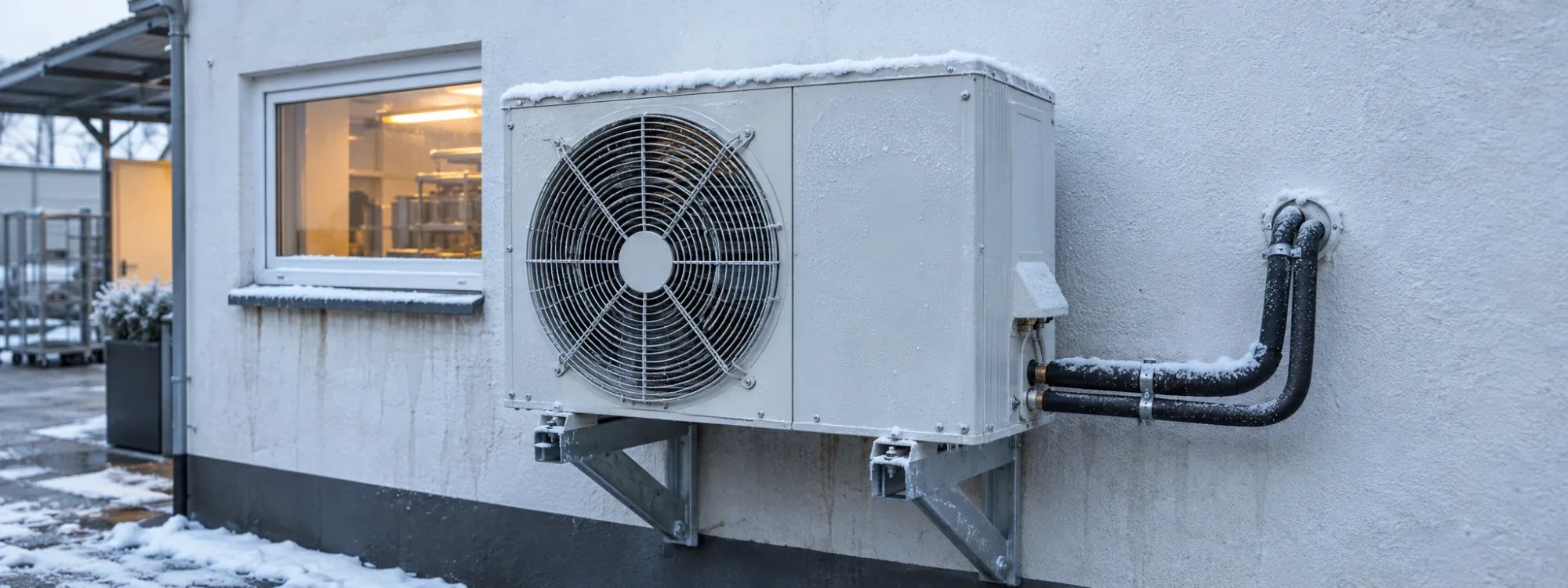
Refrigeration systems in winter: why frost (low ambient temperature) causes faults and what helps
In summer a refrigeration system struggles with heat, in winter with the opposite. If the air-cooled condenser or the condensing unit is installed outdoors, cold outside air cools it more than the system needs. That sounds like an advantage, but it often leads to faults: the cold room does not reach its temperature, the low-pressure switch trips, or the compressor starts with diluted oil.
How to recognise the problem
- The cold room does not reach its temperature in frost, but does in mild weather.
- Low-pressure faults become more frequent on cold nights.
What happens in the system in frost
The high pressure drops. The condensing pressure follows the outside temperature: the colder the air at the condenser, the lower the pressure on the high-pressure side.
The expansion valve gets too little pressure. How much refrigerant a thermostatic expansion valve lets through depends on the pressure difference between its inlet and outlet. If the high pressure drops too far, too little refrigerant reaches the evaporator. The suction pressure falls, cooling capacity is lacking, and the low-pressure switch can shut the system down.
Refrigerant migrates into the compressor. During standstill, refrigerant collects at the coldest point of the circuit, for a compressor installed outdoors often in the crankcase. There it dissolves in the oil. At the next start the oil is diluted and lubrication suffers; in extreme cases there is a risk of liquid slugging.
Three remedies
1. Control fan speed by pressure
A fan speed controller measures the condensing pressure or, depending on the model, the condensing temperature and lets the fans run slower when it falls. This keeps the pressure in a range the expansion valve can work with. Danfoss names speed control as the first choice. Examples are the Danfoss RGE-Z1N4-7DS and the Dixell XV 105 D; more under fan speed controllers.
2. Condensing pressure regulator with receiver pressure regulator
If the outside temperature varies a lot, speed control alone is often not enough: below its control range the fans only run at minimum speed or switch off. Then a condensing pressure regulator such as the Danfoss KVR is added. How it maintains the pressure depends on where it is installed. The usual position is between condenser and receiver: there it backs up liquid refrigerant in the condenser. This leaves less surface for condensing, and the pressure rises. The differential pressure valve Danfoss NRD ensures sufficient pressure in the receiver. For this solution the system needs more refrigerant and a receiver that can hold this additional charge in summer, when it is not in the condenser. If condenser and receiver are installed outdoors in very cold surroundings, starting after a long standstill can be difficult. In that case the KVR is installed ahead of the condenser, and the NRD sits in a bypass line around the condenser. Danfoss recommends setting the regulators during winter operation.
3. Crankcase heater
A crankcase heater keeps the oil in the compressor crankcase warm during standstill, so that less refrigerant collects there. It stays switched on during standstill periods. Danfoss supplies matching heaters for each series, for example the 7773107 for SM/SZ084–161 and MT(Z)044–081. If the compressor has been without power, Copeland requires for its scroll compressors that the heater is switched on at least 12 hours before start-up. For other compressors, follow the manufacturer's instructions.
Checklist before the first frost
- Fan speed controller fitted and set correctly?
- Crankcase heater warm during standstill? Check connection and fusing.
- With condensing pressure regulators: is the receiver large enough for the additional charge in summer, and are the regulators set for cold weather?
- Low-pressure switch set to suit the system?
- Freezer rooms: drain line heater in order, especially where the drain runs through cold areas or ends outside the building?
Adjustments to the refrigerant circuit and work with refrigerant must only be carried out by certified personnel.
Sources
Was this post helpful?
Thank you for your feedback!