


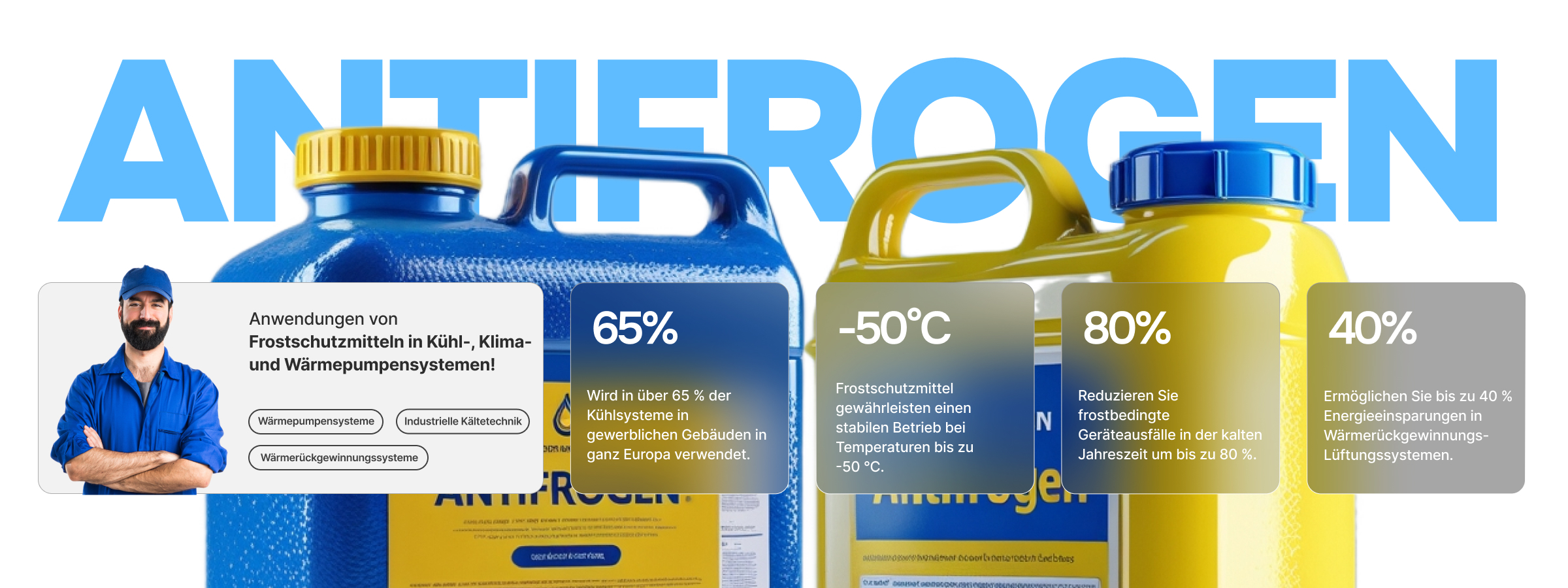
Glycol in Refrigeration Technology: Efficient Antifreeze for Cooling and Heating Systems
Glycol in Refrigeration Technology: Efficient Antifreeze for Cooling and Heating Systems
Why This Topic Matters Now:
Whether in industry, commerce, or building technology – safe heat and cold transfer are crucial for smooth operation. Especially in colder seasons, systems without proper antifreeze protection can quickly freeze up. Glycol plays a key role in preventing this.
What You Will Learn in This Article:
You will discover how glycol functions as both a heat transfer fluid and antifreeze, the differences between ethylene glycol and propylene glycol, where each type is typically used – and which proven products are available from H+H Kältetechnik.
1. Glycol – The Invisible Helper in Cooling and Heating Systems
Glycol is a dihydric alcohol that serves as the base for many antifreeze and heat transfer fluids. When mixed with water, it lowers the freezing point and raises the boiling point of the fluid – ensuring the system remains liquid and operational even under extreme temperatures.
1.1 Why Glycol Is Essential
In refrigeration units, heat pumps, and heating systems, glycol reliably protects pipes, heat exchangers, and pumps from frost damage. It is standard in outdoor units, evaporators, and solar collectors. At the same time, it provides corrosion protection and extends the service life of metallic components.
2. How Glycol Works in Practice
Glycol mixes completely with water and modifies its physical properties. Even at a concentration of 20–30%, the mixture can protect against freezing down to approximately –10 °C.
- Antifreeze: Glycol binds water molecules and prevents the formation of ice crystals.
- Heat Transfer: Due to its higher boiling point, the mixture can absorb and transport more heat.
- Corrosion Protection: Modern products include inhibitors that protect metals such as copper, aluminum, and steel.
Note: As glycol concentration increases, viscosity also rises, slightly reducing pump efficiency and heat transfer. Regular system checks and choosing the right glycol product are therefore essential.
3. Ethylene Glycol vs. Propylene Glycol – Choosing the Right Type for Your System
| Property | Ethylene Glycol (EG) | Propylene Glycol (PG) |
|---|---|---|
| Thermal Conductivity | Higher | Slightly lower |
| Freezing Protection | Very effective | Slightly weaker |
| Viscosity | Lower | Higher (thicker) |
| Toxicity | Toxic, not food-safe | Non-toxic, food-safe |
| Typical Application | Closed industrial systems | Food, pharmaceutical, and solar systems |
3.1 When to Use Ethylene Glycol
Ethylene glycol is commonly used in closed cooling and heating circuits, such as industrial process chillers or heat pumps. It provides excellent heat transfer performance at low cost – but must not be used in areas with potential food contact.
3.2 When Propylene Glycol Is the Better Choice
Propylene glycol is food-safe (FDA-approved) and significantly less toxic. It is often used in breweries, dairies, pharmaceutical applications, and solar thermal systems. While its thermal conductivity is slightly lower, PG offers the highest levels of safety and environmental compatibility.
4. Sustainability and Safety in Focus
Modern glycol-based fluids are biodegradable and formulated with environmentally friendly corrosion inhibitors. However, users should always wear gloves and eye protection during filling or draining and dispose of used fluids responsibly.
Many modern glycol products include bittering agents to prevent accidental ingestion by humans or animals – an important contribution to safety and environmental protection.
5. Products & Solutions from H+H Kältetechnik
Our antifreeze product range includes trusted brands such as:
- Antifrogen® N (Ethylene Glycol): Ideal for closed cooling systems, protects down to approx. –10 °C (at 20% mixture).
- Antifrogen® L (Propylene Glycol): Food-grade, ideal for breweries, solar, and heating systems.
- Antifrogen® KF: Special potassium formate-based solution for deep-freeze applications down to –50 °C.
- Tyfocor® L: Propylene glycol concentrate for hygienically sensitive systems.
- Neutragel® Neo: High-performance product with organic inhibitors for long-lasting corrosion protection.
All products are ISO 9001 certified, available as concentrates or ready-to-use solutions, and can be easily mixed with demineralized water.
Conclusion: Reliable Antifreeze Protection Starts with the Right Type of Glycol
Glycol ensures operational safety, energy efficiency, and long system life in refrigeration and heating applications. The choice between ethylene glycol and propylene glycol depends on your system type – the key is balancing performance, safety, and environmental impact.
👉 Contact us for individual consultation or a tailored offer for your system.
Was this post helpful?
Thank you for your feedback!